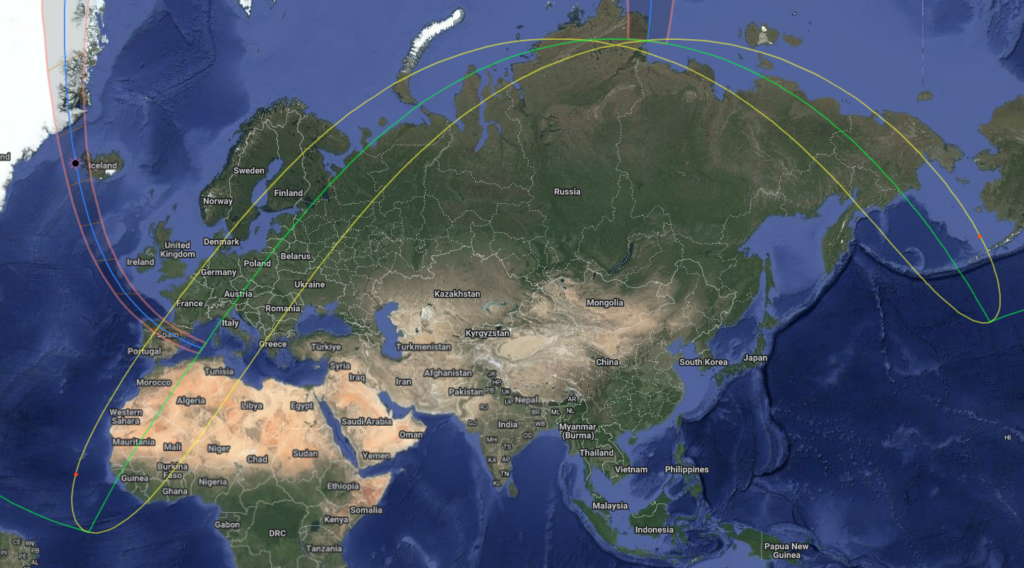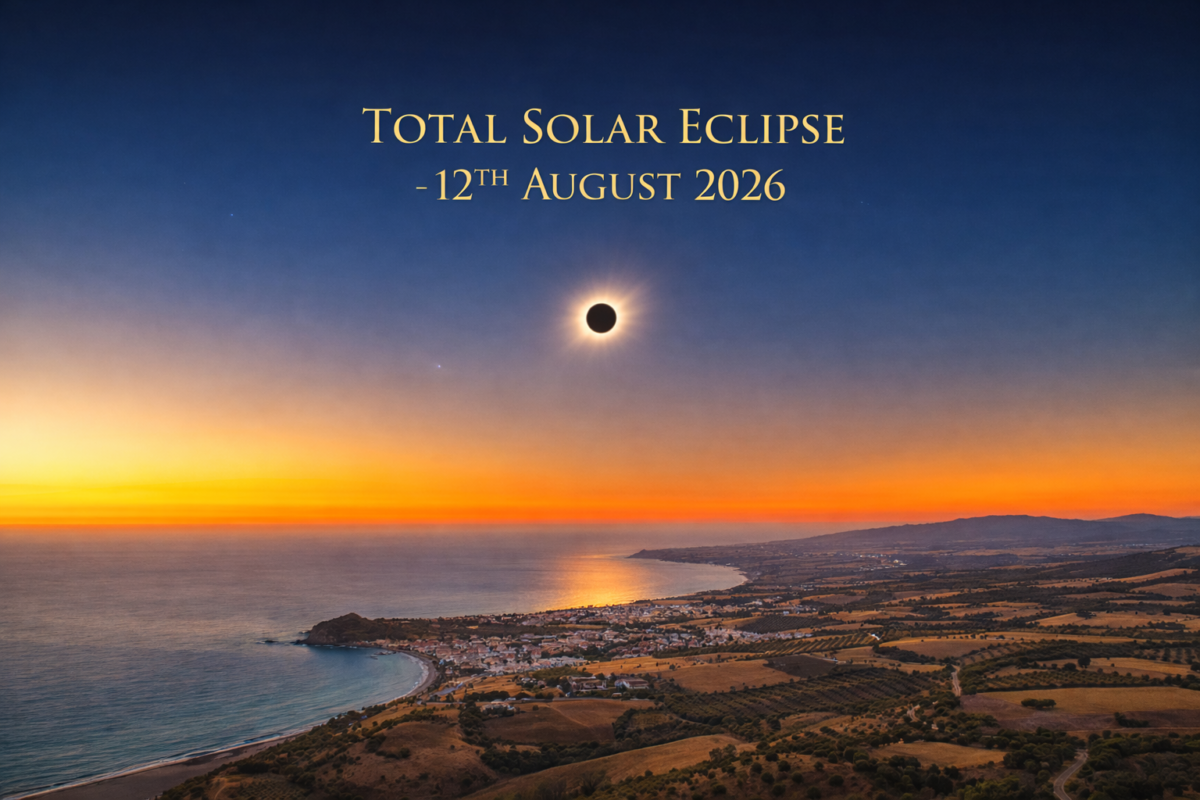
On 12 August 2026, a total solar eclipse will sweep across parts of the Northern Hemisphere, offering one of the most dramatic and scientifically significant sky events of the decade. During this event, the Moon will pass directly between Earth and the Sun, fully obscuring the solar disc for observers located within the narrow path of totality.
Path of Totality
The path of totality is the narrow corridor where the Sun will be completely obscured. Outside this path, observers will see only a partial eclipse.
Key regions along the totality path include:
Arctic Russia and the High Arctic
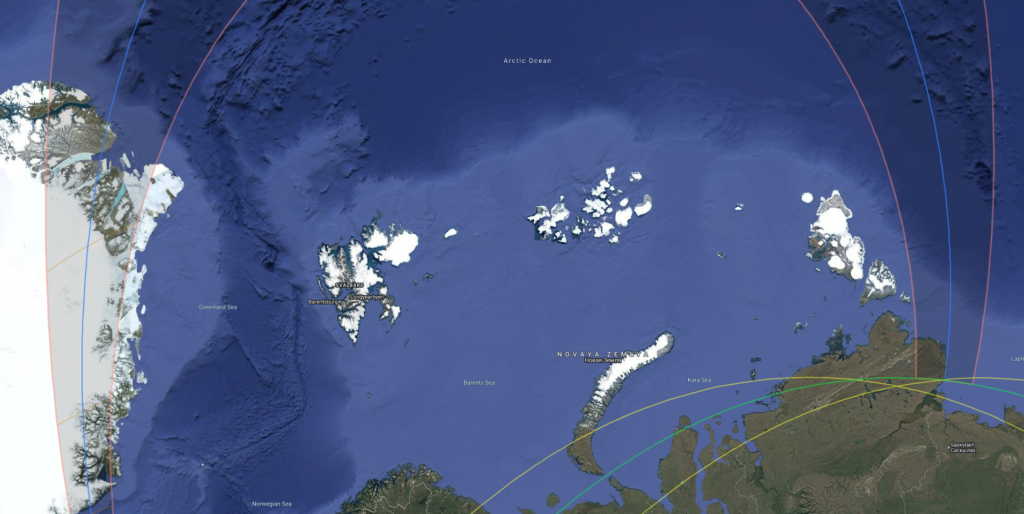
The 12 August 2026 total solar eclipse begins in the remote reaches of the High Arctic, where the Moon’s umbral shadow first touches the Earth’s surface in northeastern Russia before sweeping across the Arctic Ocean. At these extreme northern latitudes, the eclipse unfolds under remarkable conditions, with parts of the region experiencing continuous summer daylight due to the Midnight Sun. Against this backdrop, the advancing shadow creates an extraordinary spectacle as daylight briefly gives way to twilight beneath the Moon’s path.
This opening stage of the eclipse occurs far from major population centres, crossing some of the most isolated landscapes on Earth. Observations from this region are expected to come primarily from scientific expeditions, specialist eclipse observers and small Arctic communities, with access often requiring significant planning and travel. Despite its remoteness, the Arctic segment plays a crucial role in the eclipse’s progression, marking the moment when the Moon’s shadow first establishes its path across the planet.
As the eclipse continues westward across the Arctic Ocean, the shadow gathers significance on its journey towards Greenland, Iceland and mainland Europe. Although relatively few people will witness totality from these northern regions, the combination of pristine Arctic scenery, vast open horizons and the unusual lighting conditions of the polar summer makes this one of the most unique stages of the entire eclipse.
Greenland
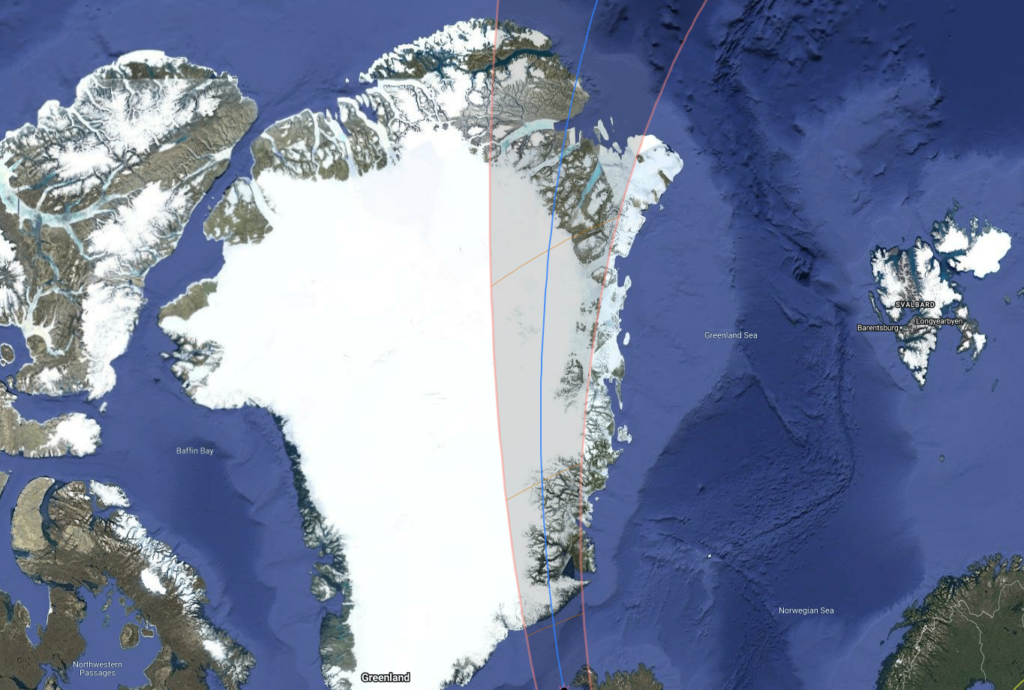
Greenland lies at the far northern end of the eclipse track and experiences the early stages of the Moon’s shadow as it moves across the Arctic. The path of totality touches eastern and northern regions of the island, where remote settlements and coastal areas fall briefly into full daylight darkness.
This part of the eclipse path is sparsely populated, meaning observations from Greenland are likely to be limited to small communities, scientific stations, and expedition groups rather than large public gatherings. Weather conditions and accessibility will be the dominant factors in determining visibility, as Arctic cloud cover can be highly variable even during summer.
Despite its remoteness, Greenland plays an important role in the geometry of the event. It sits close to the early segment of the eclipse path, where the shadow is still forming and moving rapidly across high latitudes before slowing and intensifying further south toward Iceland and Spain.
Iceland
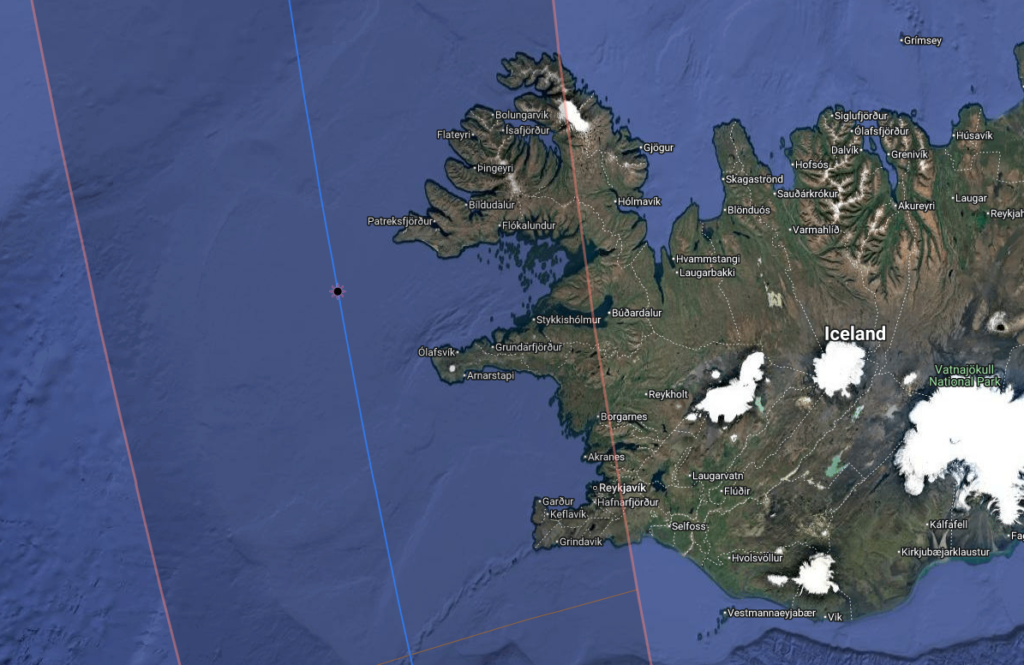
Iceland sits in one of the most favourable viewing regions for the 12 August 2026 total solar eclipse, with the Moon’s shadow sweeping across the country in the late afternoon. Large areas of the island lie within the path of totality, making it one of the most accessible and reliable land-based locations in Europe for observing the event.
Crucially, Iceland is also positioned close to the centreline of the eclipse path, meaning it will experience some of the longest durations of totality available on land during this eclipse. While the absolute point of maximum eclipse occurs offshore in the Greenland Sea—between Greenland and Iceland, where the Sun–Moon alignment is most exact—the geometry across Iceland remains extremely close to optimal. As a result, observers in Iceland can expect some of the most extended and complete totality experienced from any accessible landmass on the entire path.
The timing of totality occurs in the late afternoon, when the Sun is already lower in the sky, creating favourable contrast conditions. As the eclipse reaches totality, daylight fades rapidly into an eerie twilight, temperatures drop noticeably, and the solar corona becomes visible as a delicate white halo surrounding the blackened Sun. The combination of Iceland’s dramatic volcanic terrain, glaciers, and open horizons adds a particularly striking visual dimension to the event, with the landscape briefly transformed under deep, unnatural darkness.
Because of its combination of long totality duration, strong accessibility, and relatively high probability of clear viewing conditions compared with more remote Arctic regions, Iceland is expected to be one of the most significant global hotspots for eclipse observers, researchers, and expedition groups in 2026.
Spain
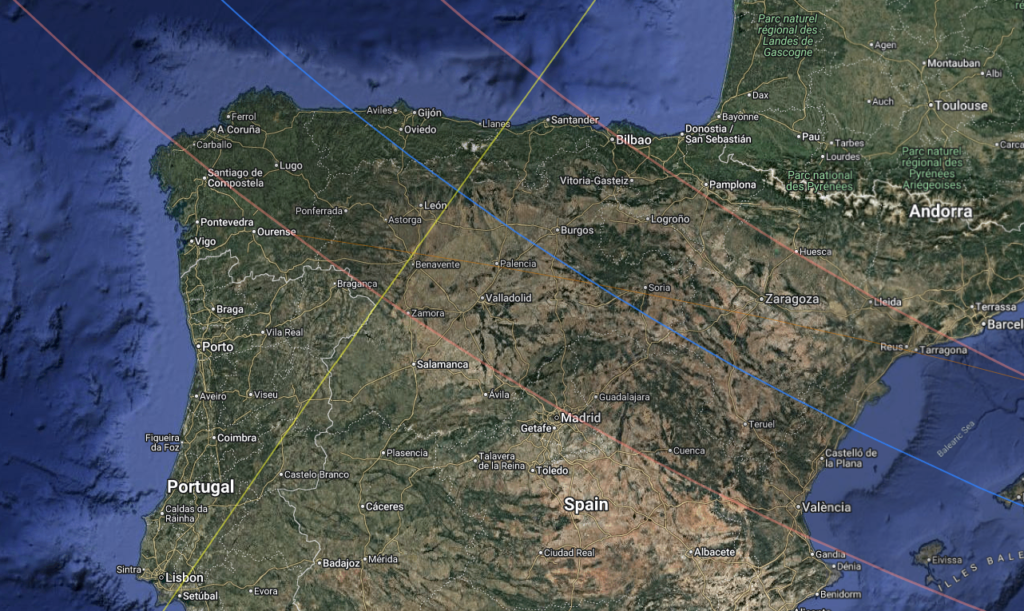
Spain represents one of the most significant and heavily anticipated landfall regions for the 12 August 2026 total solar eclipse. As the Moon’s shadow sweeps in from the Atlantic and moves across Western Europe, northern Spain lies directly within the path of totality, offering millions of people a rare opportunity to witness complete daytime darkness without leaving the country.
The eclipse track crosses the northern third of Spain, with the centreline running through or near regions such as Galicia, Asturias, Cantabria, the Basque Country, and parts of northern Aragón and Catalonia. Locations closer to the centreline will experience the longest duration of totality available on land in Spain, with maximum darkness lasting on the order of around one to two minutes depending on exact position.
This positioning makes Spain one of the most important global viewing hubs for the event. The combination of accessible infrastructure, dense population centres near the path, and well-developed transport links means large numbers of observers are expected to travel into optimal viewing zones. Cities such as those along the northern coast and inland elevated regions will become focal points for both public viewing and organised scientific expeditions.
Conditions during totality will be highly dependent on local weather, which in northern Spain can vary significantly due to Atlantic influence. Coastal regions in particular may experience cloud cover variability, while inland elevated areas may offer improved stability and clearer skies. This uncertainty is typical of eclipse viewing logistics and will likely drive significant pre-event monitoring of meteorological forecasts in the days leading up to 12 August.
During totality, observers across Spain will experience a rapid transition from full daylight to deep twilight, accompanied by a noticeable drop in temperature and a dramatic shift in ambient lighting. The Sun’s corona will become visible as a luminous, structured halo, often described as one of the most visually striking natural phenomena accessible to the naked eye.
Given its accessibility and the scale of the population within reach of the eclipse path, Spain is expected to be one of the most crowded and widely photographed viewing regions of the entire 2026 event. For many observers across Europe, it will represent the most practical opportunity to experience a total solar eclipse without extensive travel.
The Balearic Islands and Mediterranean Sea
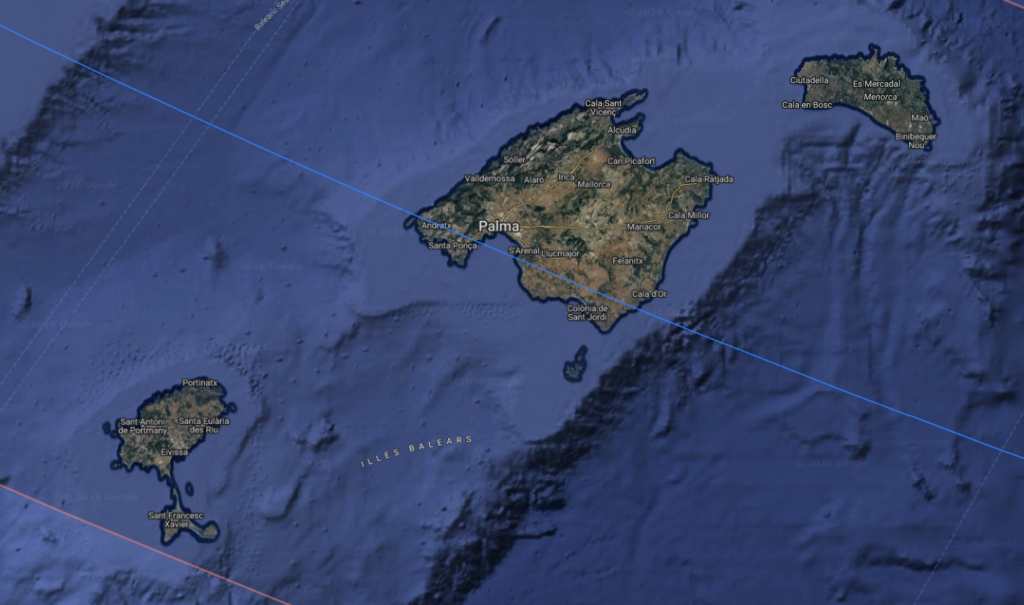
After crossing mainland Spain, the Moon’s shadow continues southeast across the Balearic Islands before moving out over the Mediterranean Sea. This archipelago—comprising Mallorca, Menorca, Ibiza and Formentera—sits along the final populated stretch of the eclipse path, where totality can still be observed but under increasingly challenging viewing geometry.
A key factor in this region is the low solar altitude during totality. By the time the eclipse reaches the Balearics, the Sun is relatively close to the horizon. This means totality occurs with the Sun appearing low in the sky, which can restrict the observable corona and reduce contrast compared with higher-altitude views earlier in the path. Atmospheric effects such as haze, humidity and sea-level extinction also become more significant, potentially softening the clarity of the corona and the surrounding sky.
Despite these limitations, the low Sun position also creates a distinctive visual effect: totality unfolds against a long, layered horizon over the Mediterranean, with twilight colours stretching across the sky and the eclipse framed in a more compressed, atmospheric setting. The result is less “overhead spectacle” and more “horizon-based eclipse landscape,” which can be visually striking but technically more dependent on clear, stable conditions.
As the Moon’s shadow exits the Balearic region and moves further across the Mediterranean Sea, it rapidly loses contact with land. The eclipse then reaches its final phase over open water, where totality briefly continues before the alignment between the Sun, Moon and Earth breaks apart and daylight returns to the region.
Interactive Eclipse Map